Sea turtle nesting season on the Wilmington-area beaches runs from May 1 through October 31, and if youâre renting oceanfront, the rule most likely to touch your week is what you do with the lights after dark. Only one of the three beach towns has written that rule into its code. Kure Beach prohibits lighting the beach at night in season, Wrightsville Beach asks, and Carolina Beach says nothing at all, so the same deck light can be a code violation on one island and nobodyâs business a few miles up the sand.
When the season actually runs
The May-to-October window covers two things happening back to back. Adult female loggerheads come ashore to lay through late spring and summer, and the N.C. Wildlife Resources Commission puts peak loggerhead nesting at May 1 through August 31 in its sea turtle fact sheet. Everything after that is incubation and hatching, which takes about 60 days, so a nest laid in mid-August is still in the sand well into October. Thatâs why the regulated season runs two months past the last eggs. If youâre picking dates around the weather instead, when to visit the Wilmington beaches covers the same months from the other direction.
The light rules, town by town
All three towns ask for the same behavior, and they diverge just as much on holes and chairs and tents as they do on light.
| Wrightsville Beach | Carolina Beach | Kure Beach | |
|---|---|---|---|
| Beachfront lights at night | Requested by the town, not codified | No rule | Prohibited May 1 to Oct 31, red light excepted (8.02.016) |
| General lighting standard | Full cut-off or shielded fixtures, 16 ft mounting cap (UDO 155.9.10) | None specific to residences | Capped at 0.1 foot-candles past a residential property line |
| Holes in the sand | Fill completely before you leave (92.17) | Max 12 in. deep, 5 ft wide, filled by 5 p.m., $50 fine (28-61) | Max 16 in. deep, 5 ft wide, attended until filled (13.14.020) |
| Gear left out | No tents, canopies, or umbrellas overnight (92.09) | Off the sand between sunset and sunrise, $100 fine (28-119) | Off the sand 7 p.m. to 8 a.m. year-round (13.14.020) |
| Clearance from a marked nest | Not specified in the code | 20 ft, and nothing seaward within 10 ft either side, $100 fine | 15 ft |
Each townâs rules above were read from its own code in August 2026.
Kure Beach
Kure Beach treats beachfront lighting as a nuisance, which is firmer ground than a request. Town code section 8.02.016 prohibits illuminating âby any light source, any portion of the beach within the Townâs corporate limits between the hours of sunset and sunrise from May 1st through October 31st except by such frequencies of red light as to not disturb nesting or hatchling sea turtles.â Turtles are named in the sectionâs stated purpose, and it was adopted in 2020 and amended in 2024.
Ordinary porch lights are exempt, two in front and two in back per story at 40 watts each, so a normal front porch isnât the target. Enforcement is also slower than âprohibitedâ suggests, since the town acts on a complaint and gives 15 days from written notice before civil penalties attach. Nobody is writing tickets from a patrol car, but a neighbor who reports a floodlight pointed at the water has a code section behind them. The townâs beach regulations page links out to the full ordinance.
Wrightsville Beach
The townâs Coastal Wildlife Protection page tells visitors to turn off or shield beachfront lights at night, fill in holes before sunset, and remove chairs, tents, and toys before leaving. It cites no code section for any of it. Chapter 92 of the town code, which is where the beach and shore regulations live, says nothing about lighting or sea turtles across its 33 sections, and its rules on holes and overnight gear are loose by comparison, with no depth limit and no clock. The first-beach-day rules at Wrightsville cover those without the ordinance numbers.
The island isnât unregulated, just regulated for a different reason. Wrightsvilleâs lighting rules live in the unified development ordinance at section 155.9.10, amended in April 2026, and they require residential dusk-to-dawn fixtures to be full cut-off or shielded. None of it names a turtle, and most of it helps one anyway.
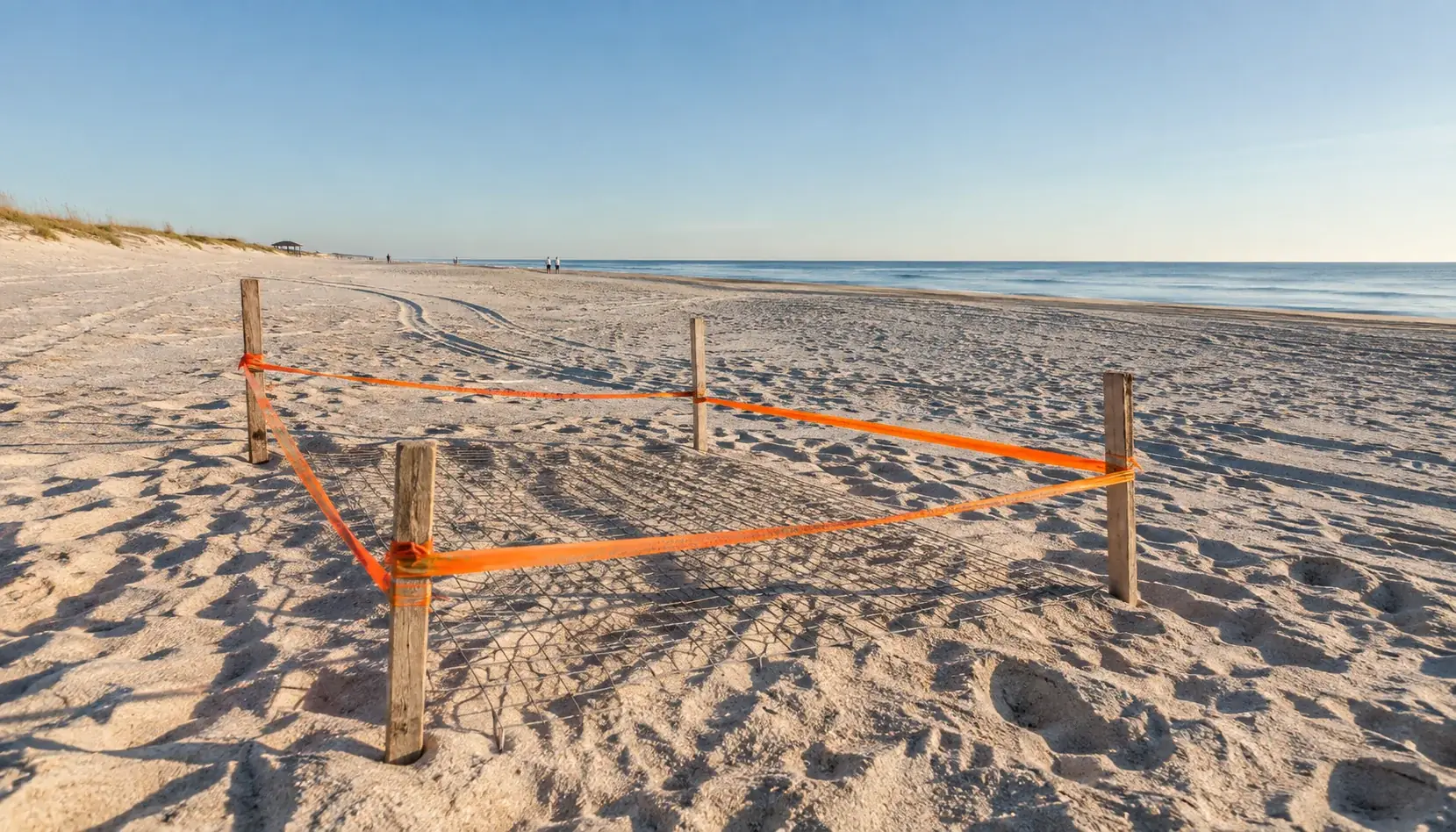
Dawn patrols here are run by the Wrightsville Beach Sea Turtle Project, whose volunteers walk the strand looking for tracks. A crawl looks like ATV tire tracks, with a flat section down the middle where the turtleâs body dragged and flipper marks on either side, about 40 inches across. Nests they find get neon orange stakes, one of the few things allowed to stay out overnight. For more on the groups doing that work, see Wrightsville Beachâs conservation community.
Carolina Beach
Carolina Beach is the outlier in both directions. Chapter 28 of its code of ordinances, which covers the beaches, sets no lighting rule at all, and the zoning standards never mention turtles. What the town has instead is the most detailed of the three sets of rules about physical objects between a hatchling and the water, and it prices them. Section 28-119 keeps beach equipment at least 20 feet from any nest, at $100, and section 28-61 requires holes to be filled before you leave and no later than 5 p.m., which is the rule most visitors donât see coming, at $50.
Freeman Park, the drive-on stretch at the north end, adds section 28-154, which requires extreme caution while driving on the beach to avoid nests, so if youâre camping out there in season, stay on the track and go slowly after dark. Carolina Beach and Kure Beach share Pleasure Island, and the Pleasure Island Sea Turtle Project patrols both on one hotline.
What the nest numbers look like
These are the totals from the SEATURTLE.ORG Nest Monitoring System, the database the stateâs monitoring programs report into.
| Beach | 2024 | 2025 | 2026 to date |
|---|---|---|---|
| Wrightsville Beach | 9 | 3 | 15 |
| Carolina Beach | 13 | 6 | 5 |
| Kure Beach | 11 | 3 | 17 |
The 2026 column is mid-season and will move, and the database describes all of its figures as preliminary. Set those totals against roughly 1,967 nests statewide and you have the scale of it, because these three beaches together are a rounding error across about 330 miles of North Carolina nesting beach. The counts also donât move in step, so a slow summer means little on its own. Loggerheads nest on multi-year cycles and return to the beaches where they hatched, which is why Kure Beach can go from 3 nests to 17 in a year while Carolina Beach, three miles up the same island, goes the other way.
What to do if youâre renting oceanfront
Close the blinds and draperies in oceanfront rooms after dark. The wildlife commission lists this ahead of most of its other advice, because indoor light through a glass slider reaches the sand as well as a floodlight does, and itâs the one fix that doesnât involve touching the wiring. Then walk outside after sunset and look back at the house, since anything you can see lighting the sand is the problem.
Bring a red flashlight if you walk the beach at night, or bring none at all, because the commissionâs instruction is to use your natural vision and moonlight and red is the only light Kure Beachâs ordinance carves out. Skip beach campfires during the season, since hatchlings are drawn toward the light and crawl into them. Carry the chairs and umbrellas off every evening, and fill in every hole your family digs, including the ones that looked too small to matter, because both stop a two-inch hatchling that gets one trip to the water. If you do find a turtle in trouble, the hotline for your beach is below, and the animals that need months of care go up the coast to the Karen Beasley Sea Turtle Rescue and Rehabilitation Center at Surf City.
FAQs
What should I do if I find a nest, hatchlings, or a nesting turtle?
Call the volunteers who patrol that beach and leave everything where it is. At Wrightsville Beach thatâs the Wrightsville Beach Sea Turtle Project hotline, 833-4-TURTLE (833-488-7853). At Carolina Beach and Kure Beach itâs the Pleasure Island Sea Turtle Project, 888-290-1065, and the statewide line is 252-241-7367. If a female is coming ashore, the Pleasure Island project asks you to give her about 30 feet, stay out of her line of sight, and keep lights and flash photography off her, since either can make her abandon the nest. Leave the tracks alone too, because volunteers read them to identify the species and locate the eggs.
Can I watch a nest hatch?
Almost certainly not on purpose. Loggerheads hatch at night and can emerge any time between dusk and dawn, and the Wrightsville Beach Sea Turtle Project puts incubation anywhere from 45 to 70 days, give or take two weeks on either side. Neither local project publishes nest locations or expected emergence dates. What is open to the public is the free WBSTP turtle talk, every Tuesday evening in June, July, and August at 7 p.m. at the N.C. Coastal Federation office on West Salisbury Street. The N.C. Aquarium at Fort Fisher, the usual fallback for seeing a turtle up close, closed in May 2026 for a 30-month expansion, though it runs a smaller Discovery Bay space at Independence Mall meanwhile.
Which town you booked decides which rules youâre under
Three beaches inside twenty miles give you three different answers about the light on your deck. Kure Beach can make you turn it off, Wrightsville Beach will ask you to, and Carolina Beach will leave the light alone and fine you for the hole your kids dug. Find out which set youâre under before the first evening, because all three towns want the same behavior either way, and on a beach where a good year is fifteen nests, one disoriented brood is a meaningful share of it.