For your first Wrightsville Beach day, settle three decisions before packing: where you’ll park, whether the dog or bikes can go onto the sand, and which access suits your group. October changes the dog and bike rules, but it doesn’t end the town’s paid parking season. For boards, add the surfing map to that plan.
Match your plan to the seasonal rules
The town’s beach information page gives the dog and bicycle wording. Keep these two activities separate when deciding what to bring.
| Bringing | Published strand rule | What it means for your plan |
|---|---|---|
| A dog | Allowed October 1–March 31, leashed; owners must collect waste | From April through September, leave the dog out of the beach plan even for an early or late walk |
| A bicycle without a throttle | Permitted at any time between October 1 and April 1; prohibited 10 a.m.–5 p.m. between April 1 and October 1 | During the restricted season, choose a permitted time or a suitable land route |
| A bicycle with a throttle | Excluded from the beach strand permission | Don’t treat the seasonal bicycle allowance as permission for throttle-equipped bikes |
The bicycle source uses April 1 and October 1 as both seasonal boundaries. For a boundary-date ride, ask the town which restriction applies that day. Permitted hours also don’t guarantee that tide, sand or crowd conditions will make a ride practical.
Parking: the Municipal Complex has its own terms
The parking hub lists the March 1–October 31 paid season, seven days a week, and says rates and hours vary by location. Read the sign for the space you actually use. A pier’s parking summary or a friend’s receipt from another lot may have different terms.
At the Municipal Complex, the town lists 9 a.m. to 7 p.m. enforcement and $5 per hour in that season, with the first two hours free after plate registration on arrival. Register at the relevant kiosk or follow that location’s posted Text2Park instructions. Don’t assume that parking without payment automatically activates the allowance.
For a two-hour Loop outing, the allowance may cover the stop. A longer beach day needs a budget for the extra hours or a different signed space. Keep your confirmation and check the plate entry before leaving the vehicle. Our beach parking guide compares the separate towns’ systems.
Surfing: fixed buffers and flagged zones
The town surfing page requires a board leash and prohibits surfing within 350 feet of Johnnie Mercer’s Pier, 350 feet of Crystal Pier, and 100 feet of the Masonboro Inlet Jetty. Its maps identify the associated accesses.
From Memorial Day weekend through Labor Day weekend, no-surf areas also operate in front of staffed lifeguard stands. The town specifies 600–750-foot lengths, marked with flags, and allows additional posted zones for conditions or events. Read the flags where you enter and ask a lifeguard when the boundary is unclear.
Those rules regulate surfing. They don’t establish a universal fishing buffer or certify that the same area is safe for swimming. Swimmers should follow current lifeguard directions; anglers need to avoid casting across other beach users and check any separately posted fishing restrictions. The pier-versus-charter guide covers the fishing choice and licensing.
Kite gear needs the town’s separate instructions on the same surfing page, including entry areas and separation from flagged zones. Read them before bringing equipment rather than treating an ordinary board rule as the full kiteboarding policy.
Choose an access that meets your group’s needs
The accessibility page places an access mat at the south-facing E. Salisbury Street beach access. The town warns that sand, weather and maintenance can affect it. An access mat isn’t a promise that the entire route or beach surface will suit a particular mobility device on your day.
The town also offers sand wheelchairs without a charge, using an account-and-phone reservation process. Pickup and return are at the park office Monday through Friday, 8 a.m. to 4 p.m.; the listed reservation contact is 910-256-7925. Arrange the chair, transport and office timing before a weekend trip, rather than expecting a walk-up chair at the beach.
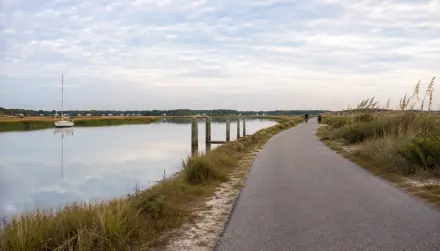
For a paved alternative, the Nesbitt Loop is a 2.45-mile sidewalk route, with restrooms at Wrightsville Beach Park. The Loop, pier and museum walk helps plan that outing. Decide on the parking period and the route together so an extra stop doesn’t unexpectedly extend your stay.
At the access, read the current sign
The police department posts the town beach-rules sign at beach accesses. This guide covers selected first-visit decisions; the sign and current ordinances carry other restrictions that may affect what you’re bringing.
Pack out litter and personal gear, stay out of marked turtle nest areas, and use the turtle-season guide for wildlife contacts and protective practices. For a dog outing, keep the actual strand season above in view rather than applying another beach town’s hours.
Leave room for lunch and a change of plan
Choose the access and parking first, then fit food around the route. Our kid-friendly Wrightsville lunch guide helps with that next stop. For weather that sends you indoors, the rainy-day guide gives alternatives. Keeping the car’s parking expiry and your return route in mind makes either change easier.