The line items in our three-night planning example for two total $720 to $1,370; the seven-night example for a family of four totals $2,880 to $5,055. Both exclude taxes, lodging fees, tips, and travel to North Carolina, among the exclusions listed below. These planning ranges show their lodging, food, driving, parking, and activity inputs so you can replace them with prices for your dates.
Lodging sets the scale of the budget
Accommodation is the largest line in the examples below. The couple’s lodging allowance assumes three nights at $150 to $250 per night before taxes and fees. The family’s allowance is $2,000 to $3,500 for seven nights, about $286 to $500 per night. These are chosen planning inputs rather than a survey of available rooms. Replace them with an all-in quote for your dates before committing to a budget. The guide to where to stay near Wilmington’s beaches helps narrow the town and property type first.
What visitors spent in New Hanover County
Visitors spent $1.206 billion in New Hanover County in 2025, according to The Economic Impact of Travel on North Carolina Counties, prepared by Tourism Economics for Visit North Carolina. That was 3.2 percent of statewide visitor spending and supported an estimated 7,250 jobs. These county totals describe the local visitor economy and provide context for the household examples below.
| Category | New Hanover County, 2025 |
|---|---|
| Food and beverage | $383.10M |
| Lodging | $311.46M |
| Transportation | $267.57M |
| Recreation | $154.08M |
| Retail | $89.89M |
| Total visitor spending | $1,206.11M |
Food and beverage exceeds lodging in the county data, but the categories cannot be applied directly to one vacation. The totals include day visitors who buy meals without booking a room, and the lodging category includes second-home spending. In the two overnight scenarios below, the stated lodging assumptions make it the largest line.
New Hanover visitor spending rose 5.8 percent in 2025 over 2024. The statewide series reached $37.2 billion, up 1.3 percent. Those figures measure total spending, which changes with visitor volume and prices, so they should not be read as lodging inflation.
The published sector figures sum to $1,206.10 million, $0.01 million below the published total because the source rounds each category separately. Lodging includes second-home spending and transportation includes ground and air travel. Neither total measures the price of a particular vacation.
What each line item costs in 2026
The following local prices were checked in September 2026. Confirm them on the linked official pages before booking because rates and schedules can change.
| Beach | Hourly | Full day | Paid season |
|---|---|---|---|
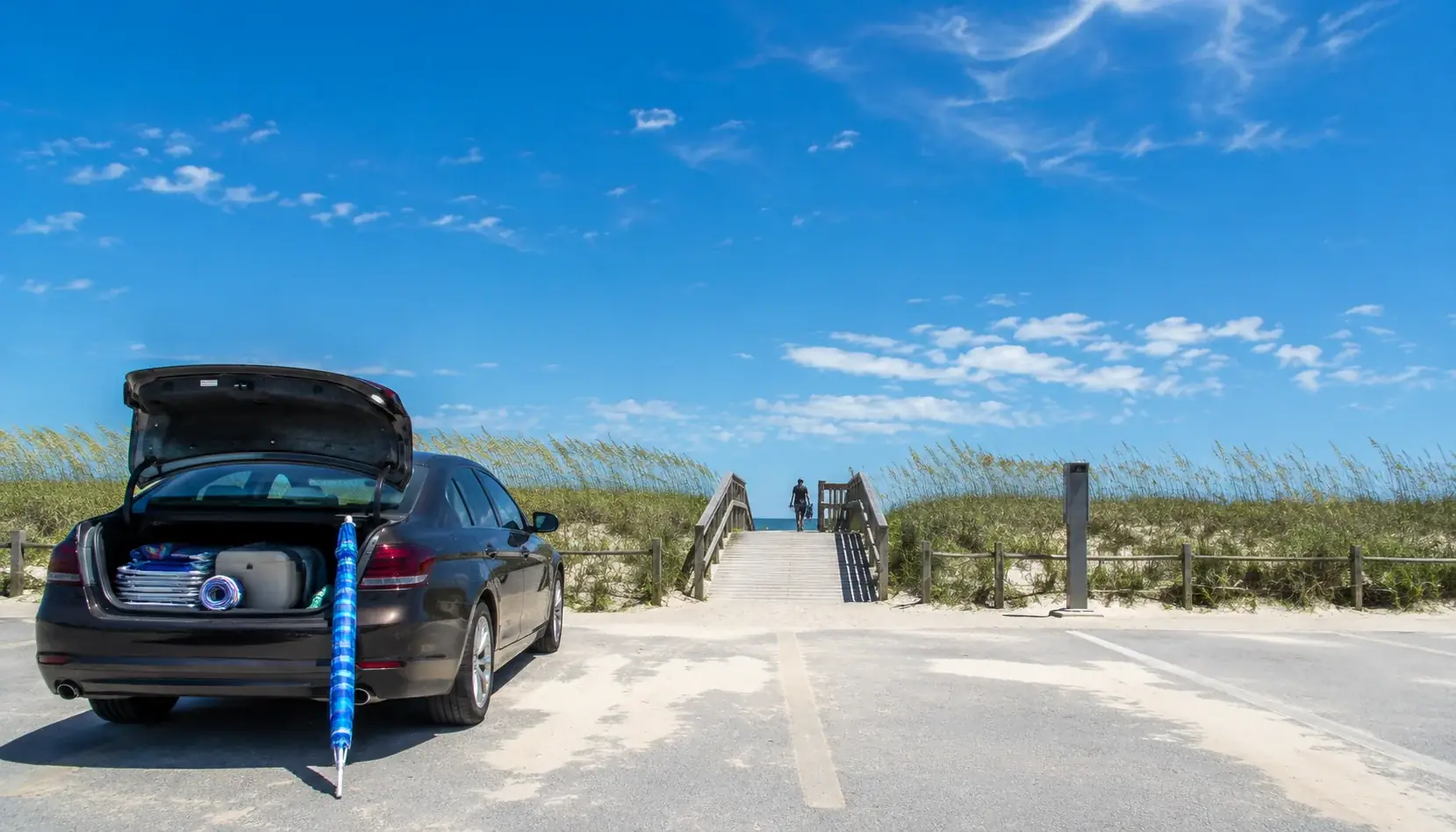
| Wrightsville Beach | $3 one-hour spaces, $5 non-premium, $6 premium | $25 non-premium, $30 premium | Mar 1 to Oct 31, 9am to 8pm premium, 9am to 7pm non-premium |
| Carolina Beach | $5 on-street, $6 town lots, $7 premium lots | $25 town lots, $35 premium | Mar 1 to Oct 31, 9am to 8pm; premium lots year round |
| Kure Beach | $6 | $25 (or $125 for the week) | Mar 15 to Sep 30, 8am to 6pm |
A few things in that table need context before you arrive. Wrightsville lowered its rates in early 2026 and added a real-time space-availability system, so the figures are friendlier than a year ago, and you pay by text or at a pay-by-plate kiosk rather than leaving a receipt on the dash. Carolina Beach runs on a Text-2-Park app and is the one town where the off-season doesn’t fully let you off, since its premium lots stay enforced all year. Kure sells tiered season passes tied to your plate, priced from $50 to $225 depending on when you buy, and its season is both shorter and earlier than its neighbors’. If you’re parking at Wrightsville most days of a week-long stay, price the $210 weekly pass against $25 to $30 a day before you assume the pass wins.
Confirm your dates against the Town of Wrightsville Beach parking page or the Carolina Beach parking page; for how the lots and passes work on a first beach day, our Wrightsville Beach first-visit guide covers the ground-level details.
Use these admission prices to choose activities within your allowance.
| Attraction | Adult | Child | Notes |
|---|---|---|---|
| Battleship NORTH CAROLINA | $14 | $6 (ages 6 to 11) | Ages 5 and under free; seniors $10; sales tax extra |
| Airlie Gardens | $10 | $3 (ages 4 to 12) | New Hanover County residents $5; special events excluded |
| Southport to Fort Fisher ferry | $7 per car | Included in the car | Vehicle under 20 feet; walk on for $1, under 5 free |
| Fort Fisher State Historic Site | Free | Free | Grounds and visitor center |
| The beaches | Free | Free | You pay to park, not to swim |
Admission figures come from each site directly, the Battleship and Airlie Gardens among them, and the ferry fare from the NCDOT ferry schedule. Families planning around Kure Beach should know that the NC Aquarium at Fort Fisher closed in May 2026 for a multi-year expansion, so it isn’t an option this year.
Food and driving depend on choices the official price tables cannot settle. A rental with a kitchen can replace restaurant meals with groceries, and the guide to eating well on a beach budget covers that tradeoff. Fuel depends on your starting point, vehicle, and trips between towns. If you are driving from Atlanta, the Atlanta to Wilmington drive guide gives the route distance to use in your calculation.
Two trips, two budgets
These September 2026 examples assume one vehicle. The couple stays three nights in shoulder season; the family stays seven nights in summer. Lodging, food, fuel, parking, and activities are included. The listed totals exclude sales and lodging taxes, cleaning charges, booking or resort fees, tolls, tips, shopping, alcohol, and travel to North Carolina. Food and activities are discretionary allowances. Fuel is a local-driving allowance; calculate your journey to the coast separately.
| Line item | Couple, 3-night weekend (shoulder season) | Family of 4, 7-night week (summer) |
|---|---|---|
| Lodging | $450 to $750 | $2,000 to $3,500 plus fees |
| Food | $180 to $350 | $600 to $1,000 |
| Gas and driving | $40 to $90 | $60 to $130 |
| Beach parking | $0 to $60 | $100 to $175 |
| Activities | $50 to $120 | $120 to $250 |
| Sum of listed ranges | $720 to $1,370 | $2,880 to $5,055 (see exclusions above) |
For the couple, the endpoints are $450 + $180 + $40 + $0 + $50 = $720 and $750 + $350 + $90 + $60 + $120 = $1,370. The family endpoints are $2,000 + $600 + $60 + $100 + $120 = $2,880 and $3,500 + $1,000 + $130 + $175 + $250 = $5,055. Adding all lower or upper bounds shows the range of these assumptions; it does not describe a typical booking.
The couple’s $0 parking case requires days outside the paid season or parking already included with lodging. The $60 upper case covers two $30 Wrightsville premium days. The family parking allowance covers four to seven $25 town-lot days. For food, the couple allowance is $45 to $87.50 per day over four calendar days; the family allowance is $75 to $125 per day over eight calendar days. Those meal budgets require choosing groceries and restaurant meals to fit the allowance.
To replace the fuel allowance, divide your planned miles by your vehicle’s miles per gallon and multiply by the pump price. For activities, two adult Battleship admissions and two adult Airlie admissions total $48 before the Battleship’s sales tax, leaving $2 within the couple’s lower $50 activity allowance before tax.
How to bring the number down
The savings live in a few decisions, and none of them is “see less.”
Timing is the biggest one. Late spring and early fall bring lower rates and thinner crowds while the water stays warm, and once each town’s paid season closes, most of the parking line goes away with it. Carolina Beach’s premium lots are the exception that keeps charging year round. A shoulder-season week can cost less than the identical week in July, sometimes by hundreds of dollars on the room alone.
A kitchen is the second. Because food is where a family’s spending piles up, a whole-house rental or a condo with a full kitchen lets you cook breakfast and pack lunches and save the restaurants for the dinners worth it. Our guide to choosing between a rental, hotel, condo, or bed and breakfast walks through which property types come with that kitchen and which fees to check first.
The third is leaning on what is already cheap or free. The Riverwalk, the Wrightsville Beach Loop, Fort Fisher State Historic Site, and the beaches themselves cost nothing, and the $7 Southport to Fort Fisher ferry is one of the better-value half-days on the coast. Build a couple of those into the plan and the paid attractions stop feeling like an every-day expense.
Build your own number before you book
Start with the room, since that one line sets the scale of everything else, then add the smaller certainties, a couple of paid parking days, two or three admissions, groceries against a few meals out. Pick the season with your eyes open, because the same beach costs a different amount in May than it does in July. Do that math for your actual dates, confirm the current rates on each official page, and the fuzzy question of whether Wilmington is expensive turns into a real number you can plan around, with room left over for a frozen drink facing the water.
FAQs
Are there extra fees like cleaning or resort fees on Wilmington rentals?
Often, yes. Whole-house and condo rentals usually add a cleaning fee and sometimes a service or booking fee, which can add a few hundred dollars to a week and doesn’t show in the nightly rate. Hotels rarely charge a cleaning fee, but a few resorts add a daily amenity fee. Total the all-in price for your exact dates before you compare.
Can I skip the parking and gas costs by not bringing a car?
Partly. A downtown Wilmington stay works well car-free for the Riverwalk, dining, and history, which cuts parking and fuel. Reaching the sand is the catch, since the beaches are a drive away and paid beach parking or a rideshare replaces the cost you saved. A car-free trip makes the most sense when the river and downtown are the point and the beach is one day trip.