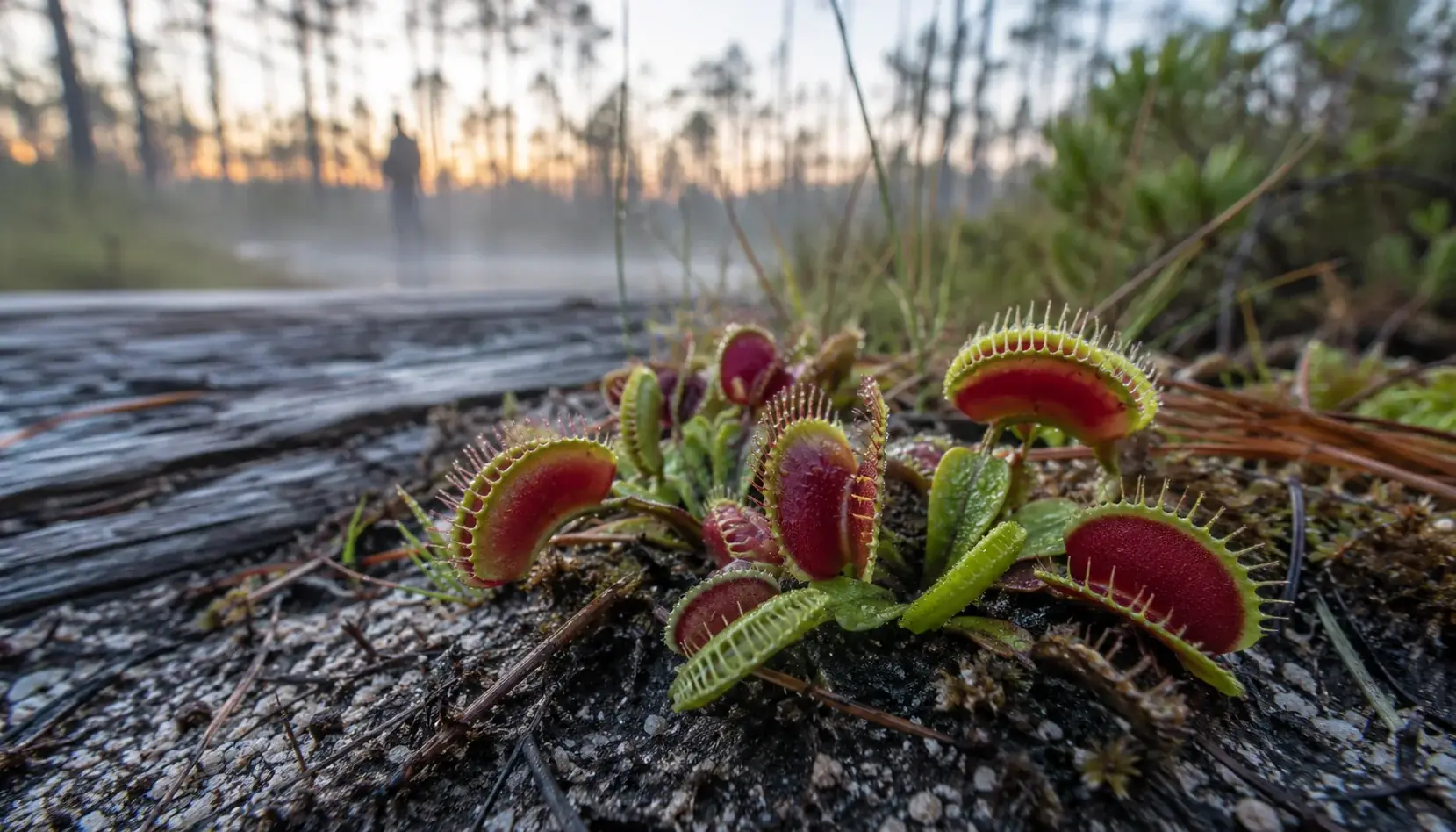
Crouch at the edge of the boardwalk on the Flytrap Trail and look low, into the wet, sandy ground a few inches off the path, and you might spot them: small green pads the size of a thumbnail, fringed with stiff teeth and blushed red inside, waiting with their jaws open. These are wild Venus flytraps, and Carolina Beach State Park is one of the only places on Earth you can see them growing where they belong. The half-mile Flytrap Trail is the easy, free way to do it, which makes this a perfect “do one genuinely strange and wonderful thing” stop for families, curious travelers, and anyone spending a day on Pleasure Island. Because it costs nothing, it also earns a spot on our roundup of free and cheap things to do in Wilmington.
Why wild flytraps grow here and almost nowhere else
The Venus flytrap has one of the smallest native ranges of any plant in the world. It grows naturally only within roughly a 75-mile radius of Wilmington, in the longleaf pine savannas and boggy pocosins of the southeastern North Carolina coast, reaching just across the line into South Carolina. Carolina Beach State Park sits right inside that narrow band and protects exactly the habitat flytraps need.
That habitat explains the strange diet. The soil here is sandy, acidic, and starved of nitrogen, the kind of ground where most plants struggle. Flytraps make up the difference by catching insects, luring them onto a hinged trap that snaps shut when a bug brushes the trigger hairs twice. The open, sunny, periodically burned savanna keeps competing brush from shading them out. Stand on the trail and you’re looking at a living argument for why this exact corner of the coast is worth protecting.
What the Flytrap Trail is like
The Flytrap Trail is a half-mile loop rated easy, and it’s built for everyone. Parts of it run along wooden boardwalks, the surface is firm, and the route is wheelchair and stroller accessible, so grandparents and toddlers can do it without trouble. Most visitors walk it comfortably in 20 to 30 minutes, longer if you stop to hunt for plants, which you should. The trailhead is at the parking area at the end of Nature Trail Lane inside the park.
Expect a short, shaded walk through pocosin wetland and pine flatwoods rather than a big scenic payoff. The reward here is small and close to the ground. The official park guidance is simply that “Venus flytraps can be seen along the edges of the pocosins.” If you want a longer leg-stretch afterward, the park’s 3-mile Sugarloaf Trail loops out to the Sugarloaf Dune, a prominent landform once used as a navigation marker, through swamp and savanna.
How to actually spot the traps
Plenty of people walk the whole loop and see nothing, because they expect the dramatic, oversized traps from photos and houseplant displays. Real wild flytraps are small, often no bigger than a thumbnail, low to the ground, and easy to stride right past. The trick is to slow down, scan the sandy edges just off the boardwalk, and look for the reddish inner pads rather than a whole bush.
You’re also not just looking for flytraps. The same wet ground supports other carnivorous plants, so keep an eye out for low rosettes of sundews glistening with sticky droplets and the taller, hollow leaves of pitcher plants. Bring a few practical things for a coastal bog in warm weather: bug spray, water, sun protection, and a phone or camera that can focus up close. Closed shoes are nice but not essential on the boardwalk sections.
When to go for the best chance
Aim for late spring and early summer. May and June are the prime months, when the plants are actively trapping and, in late spring, sending up tall white flowers on stalks held well above the traps so pollinators don’t become prey. The traps stay active through the warm months, so a summer visit still delivers, but the early-season window is the most reliable.
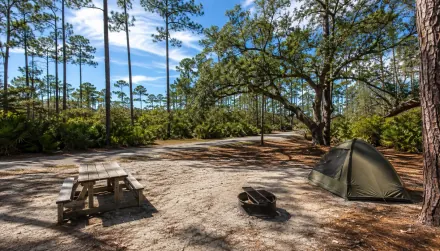
Go in the morning if you can. It’s cooler, the light is good for photos, and you beat both the midday heat and the busiest stretch on a summer weekend. Campers have the easiest time of it, since the park’s own campground puts the trailhead a short walk from the loops, and our guide to camping at Carolina Beach State Park covers the site types and how to book one. The park is open daily, with long hours in the warm season (roughly 7 a.m. to 10 p.m. from late spring through summer), and the visitor center has exhibits worth a quick look. Hours shift by season and the park sometimes runs ranger-led programs, so check current hours and any events on the Carolina Beach State Park page before you go.
Look but never pick: the one rule that matters
Wild Venus flytraps are protected, and the rule is to look, photograph, and leave every plant exactly where it grows. Since December 2014, digging up or taking a Venus flytrap from the wild in North Carolina is a felony, punishable by up to roughly two years in prison. Poaching, along with habitat loss and fire suppression, is one of the biggest threats to a species that already lives in such a tiny range, and rangers do enforce it.
Two more low-effort habits keep the population healthy. Stay on the trail and the boardwalk so you aren’t trampling the boggy ground where seedlings grow. And resist the urge to tickle a trap to watch it close, because each trap can only snap shut a limited number of times before it stops working, and a closure that catches nothing is wasted energy. If you fall for them and want one at home, that’s easy and legal. Buy a nursery-grown flytrap from a garden center or a reputable online grower instead of taking one from the wild.
Make a morning of it on Pleasure Island
The Flytrap Trail is short enough that it pairs naturally with the rest of a Carolina Beach day. Do the walk in the cooler morning, then head to the beach, the boardwalk, or Carolina Beach Lake, where the town runs free outdoor movie nights on summer evenings if your visit runs long. When everyone’s hungry, our guide to Carolina Beach breakfast and late-night spots has the early options a morning walk tends to call for. Hikers with more energy can add the Sugarloaf Trail before leaving the park.
If you’re turning this into an overnight, our guide to where to stay in Carolina Beach covers the oceanfront hotels and boardwalk inns within a few minutes of the park. First trip to the area and still choosing a home base? The Wilmington beaches lodging guide weighs Carolina Beach against Wrightsville, Kure, and downtown. And if you can’t make it to the park, you can also see flytraps closer to town at the Stanley Rehder Carolina Flytrap Garden in Wilmington, though the wild population at the state park is the bigger draw.
FAQs
Are dogs allowed on the Flytrap Trail?
Yes. Leashed dogs are welcome on the park’s trails, including the Flytrap Trail, as long as they stay on a leash no longer than six feet and you clean up after them; pets aren’t allowed inside park buildings. Keeping your dog on the path also protects the fragile bog plants growing right at the trail’s edge. Confirm the current pet rules on the Carolina Beach State Park information page before you go.
What should I do if I see someone taking flytraps from the park?
Report it rather than confront anyone. Note where you saw it and what the person looked like, then tell a park ranger or call the park office, since taking wild flytraps is a felony and rangers and state wildlife officers are the ones who handle poaching. Reporting quietly is the most useful thing a visitor can do to protect the population.
Go slow, look low, and leave them growing
Seeing a Venus flytrap in the wild is a small thrill you can only get in a handful of places, and this easy half-mile loop hands it to you for free. Come in late spring or early summer, walk slowly with your eyes on the ground, and treat every plant as something to photograph rather than pocket. Do that, and you get the rare souvenir that lasts, the memory of a wild carnivorous plant still growing exactly where it has for thousands of years.