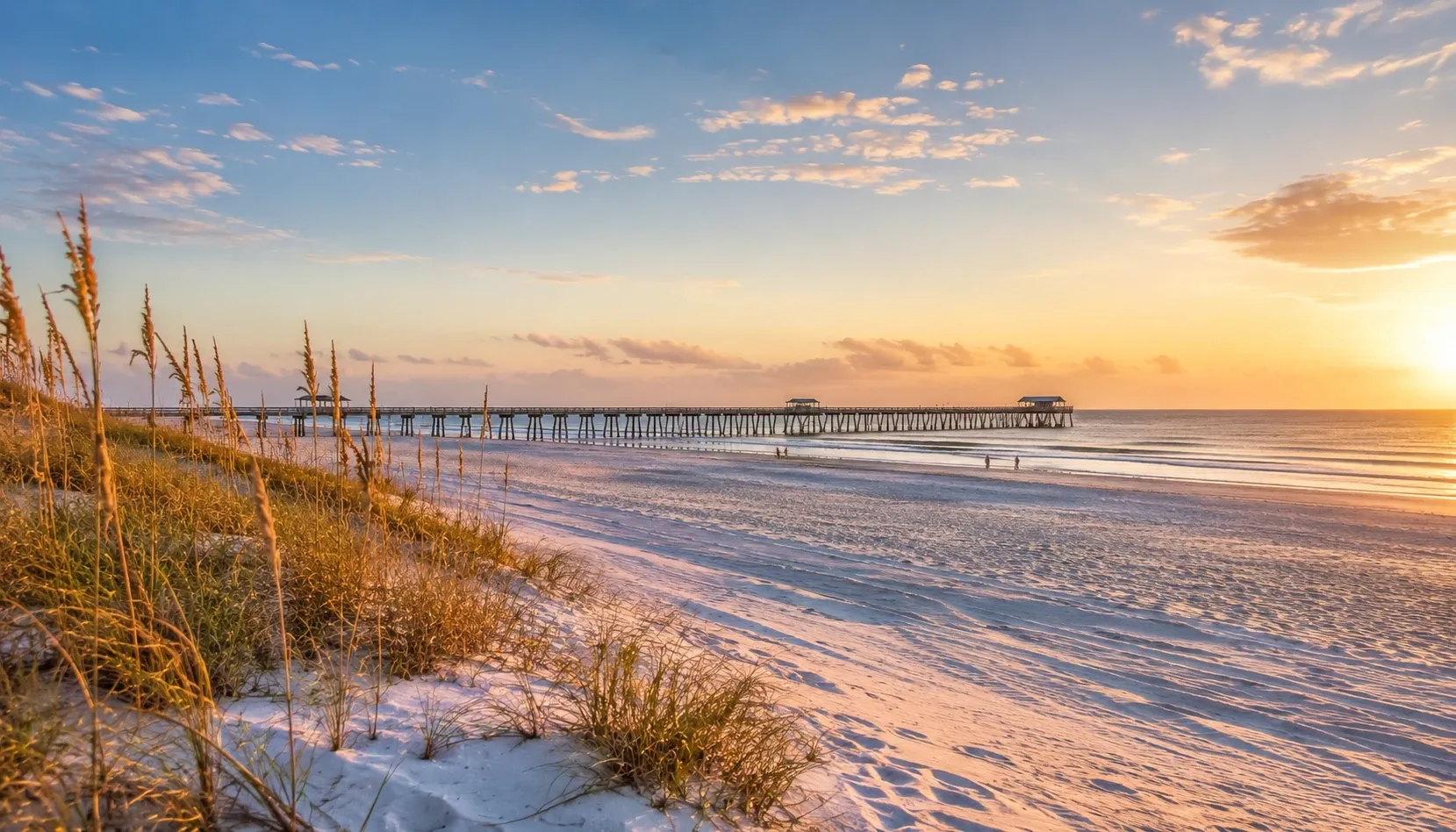
Your first hour at Wrightsville Beach goes smoother when parking, strand bikes, and surf zones are sorted before you leave the driveway, not when you’re standing at a kiosk with sunscreen in your eyes. This guide covers what to check from official town pages so your morning is sand-and-salt-first. One note upfront applies to every section below: town pages, not this article, are the live contract for fees, dates, and ordinance wording. Skim those links within a day or two of your visit.
Parking at Wrightsville Beach
The parking system here has a clear center of gravity: Pay-by-Plate kiosks run the Municipal Complex lots, and a Text2Park option lets you register your plate by phone. The Town of Wrightsville Beach Parks & Recreation page explains which lots are covered, how seasonal enforcement windows work, and where to get help if the kiosk throws an error (Parks & Recreation, Source). Read it before you arrive so the process is routine by the time you find a spot.
Island-wide rules go one layer deeper. Truck and trailer restrictions, Pivot Parking FAQs, and handicap policies all vary and live on the centralized Parking hub (Source). If you’re towing anything or parking an oversize vehicle, that page is the one to check before you assume a spot is available. Forum tips and last-year memories are useful for vibe; the Parking hub is useful for facts.
A simple habit that pays off: screenshot the kiosk instructions and lot map when you arrive, then save them to your photos. That screenshot will track annual updates more accurately than any article recap.
Strand bikes: when the beach opens to riders
If you plan to take bikes onto the beach itself, two things determine whether you can: throttle equipment and the time of year. Throttle-free bicycles may use the strand freely between October 1 and April 1. Between April 1 and October 1, bikes cannot be on the strand between 9:00 a.m. and 6:00 p.m. The Town publishes that wording on its Beach Information & Resources page (Source).
During summer hours, the sidewalks and multi-use paths feeding the Nesbitt Loop are the practical alternative. Knowing the rule before you pump tires decides whether you bring the bikes at all, which is a much easier decision in the driveway than at the access ramp.
Surf zones: near the piers and lifeguard flags
Surfing at Wrightsville runs inside a layered set of fixed and seasonal rules. The town requires leashes and prohibits reckless riding, then adds permanent exclusion zones around structures.
Year-round, surfing is prohibited within roughly 350 feet of Johnnie Mercer’s Fishing Pier, between Beach Access No. 15 and No. 16. Crystal Pier carries its own symmetric buffer, and the Masonboro Inlet Jetty zone extends about 100 feet. Those distances hold regardless of season or crowd level, so a quiet midweek offseason session still requires situational awareness on the strand. The full map and list are on the town’s Surfing & Kiteboarding page (Source).
From Memorial Day weekend through Labor Day weekend, a second layer activates: surfing is prohibited in lifeguard-flagged no-surf rectangles tied to stand placement. Flag positions shift as stands rotate and conditions change, so on-site signage is the final word, not a map you checked at checkout. The Surfing & Kiteboarding page shows how wide those zones typically run along the strand when stands are staffed.
Anglers planning to cast near a structure should read the same page. The pier buffer affects anyone working the surf line, not just boards.
The Nesbitt Loop: restrooms, shade, and a route that works
When the tide is wrong or little legs need pavement under them, the John T. Nesbitt Loop is the reliable fallback. Parks & Recreation describes it as a roughly 2.45-mile circuit that skirts the center of town, with restrooms in Wrightsville Beach Park, water fountains, and pet stations along the route (Source). Early arrivals use it while waiting for parking to settle; families use it when the beach rotation hits its limit.
The Parks & Recreation catalog in the same hub covers ADA sand-wheelchair reservations, playground locations, and seasonal programs that rotate throughout the year. If a specific amenity matters to your group, check the catalog rather than assuming availability on your date.
What the town expects from beachgoers
The Beach Information & Resources page links out to the town’s “Keep Wrightsville Beach Clean” guidance. The principle is simple: nothing stays on the sand that you brought with you. Pack-in, pack-out is the expectation rangers enforce. Treating it as automatic rather than aspirational keeps the strand nicer for the next group and keeps you clear of a ranger conversation you don’t want.
Four official links to open before checkout
Each page has one job:
- Beach Information & Resources: strand bike rules, stewardship notes, and the clean-beach link.
- Surfing & Kiteboarding: pier buffer maps, Crystal Pier zones, and summer lifeguard-flag diagrams. Open this if boards or kite gear are coming.
- Parking: island-wide rules including what changes by season for trucks and trailers.
- Parks & Recreation: Municipal Complex kiosk instructions, the Loop route, and the programs catalog.
Skim them the day before your visit, take a screenshot for offline access, and defer to on-site signage if anything conflicts.
Related reads
Once parking and beach rules are sorted, the most common next decisions are food and lodging. Our kid-friendly lunch guide near Wrightsville Beach keeps choices quick when everyone is hungry and sandy. If you’re still working out where to stay, our guide to staying near Wrightsville Beach with young kids maps the tradeoffs between rentals, condos, and hotels by family type. When radar slides east and the beach plan pivots, rainy-day things to do with kids near Wrightsville Beach has the backup options ready.
FAQs
When can you ride bikes on the Wrightsville strand?
Bicycles without a throttle may use the beach strand anytime from October 1 through April 1. From April 1 through October 1, bicycles are not allowed on the strand between 9:00 a.m. and 6:00 p.m., per the Town of Wrightsville Beach Beach Information & Resources page. Match those dates to your visit window using the town link in this article.
Where do surf and no-surf rules apply relative to Johnnie Mercer’s Pier?
Under town rules on the Surfing & Kiteboarding page, surfing is prohibited year-round within roughly 350 feet of Johnnie Mercer’s Fishing Pier, between Beach Access No. 15 and No. 16, plus year-round buffer zones at Crystal Pier and roughly 100 feet from the Masonboro Inlet Jetty. From Memorial Day weekend through Labor Day weekend, surfing is also prohibited in lifeguard-flagged no-surf zones when lifeguards are on duty. Read flags, check the town page, and let on-site signage have the final word each session.
Where should you check parking enforcement dates and municipal lot wording?
Use Wrightsville Beach Parks & Recreation for Municipal Complex kiosk instructions, Text2Park location codes, and seasonal enforcement windows. Use the Wrightsville Beach Parking page for island-wide rules including trailer and truck restrictions that vary by season. Both pages update more reliably than any blog recap.
Does this article replace lifeguard schedules or ordinance text?
No. This guide is orientation only, not legal advice and not a substitute for posted beach signs, ordinance language, or lifeguard direction. When an officer or lifeguard directs you, or when signage disagrees with any web page, defer to the people and signs on scene.
The morning without surprises
Check the four town links above within a day or two of checkout, save screenshots for spotty-signal mornings on the causeway, and let on-site signage close any gaps. Parking, bikes, and surf zones cover the three things that catch first-timers; once those are settled, the rest of the day is sand and sunscreen. If lunch is still on the planning list, our kid-friendly lunch guide near Wrightsville Beach is worth bookmarking for the midday decision.